
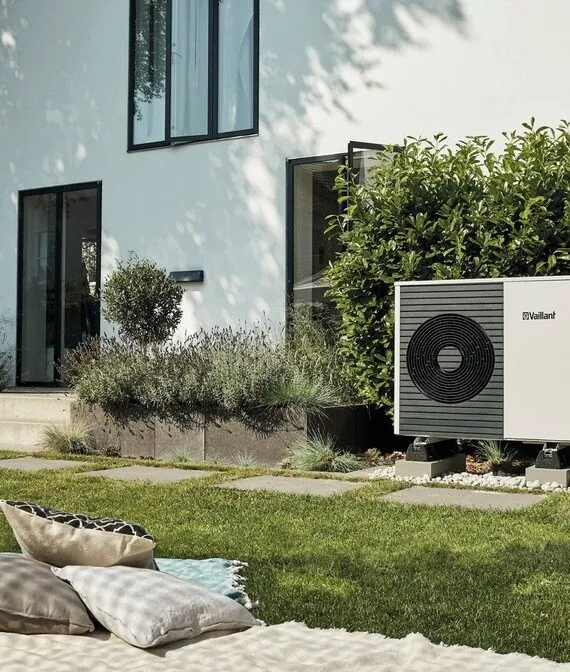
Air-source vs ground-source heat pumps. Which is better? Whilst ground source heat pumps have previously had a reputation for being more efficient, both have their pros and cons, and in this blog, we take a closer look at the types of renewable energy technology that are taking over British heating
When it comes to the ground-source vs air-source debate, the answer really does depend on your circumstances. Your property may be large and old, or you might be embarking on developing a new build property. The spectrum of housing is wide and vast, particularly in the UK, so the best technology for you and your home will vary too.
Air And Ground Source Heat Pumps
Heat pumps are ideal for well-insulated houses, especially if they have underfloor heating, and therefore tend to work best for customers with modern or new-build properties.
That’s great news for the supposedly 300,000 new homes being built each year in the UK, especially since the Future Homes Standard Announcement was made in February 2021.
The Future Homes Standards (FHS) is a part of the ‘greener buildings’ category of the government’s ‘green revolution’ 10-point plan, which sets guidelines about dealing with emissions coming from UK homes and buildings.
The FHS specifically addresses new-build houses, and regulations have been rewritten to completely eliminate traditional gas- and oil-heating systems.
Temperatures
The lower the water flow temperature, the more efficiently the heat pumps work. So with underfloor heating in a well-insulated house, heating can be as low as 35 °C.
Because the heat pump is only raising temperatures to around 40-50 degrees Celsius, it’s “easy work,” allowing the pump to achieve efficiencies of 400%+. So for every 1KW of energy supplied, a heat pump can produce 3-4KW of renewable energy.
In effect, that means the running costs of ground- and air-source heat pumps are just a quarter of those of a 100% efficient electric boiler.
To put it in monetary terms, if your electricity bill is around 24p per kWh, running a heat pump costs you only 8p per kWh. That’s considerably cheaper than oil or gas, with an 80% average efficiency.
For homes that aren’t well insulated, the heat pump has to work harder, thus reducing the overall efficiency. This is known as the ‘Seasonal Coefficient of Performance’ (SCOP).
Biomass stoves and boilers are more like oil or gas boilers and produce much higher flow temperatures, at about 70-80 °C, and are therefore more suitable for older, less well-insulated houses with traditional radiators and a high heat loss.
Which is better? Air-source or ground-source heat pumps?
Advantages Of Ground Source Heat Pumps
GSHPs gather heat from the soil, which is warmed by the sun during the summer months. The temperature below ground is more stable over the year, typically about 8 – 12 degrees C at about 1-2m down, which is the depth that shallow ground pipework is laid.
A ground-source heat pump pays dividends in winter.
While the soil temperature is about 10 °C, the winter air temperature for an air-source heat pump might be -2 °C. Conversely, in the summer months, while the soil is still at 10 °C, the air may be 20 °C, making the air source more efficient.
However, the ground source wins out over the year because when we need heating the most – in the winter – it will run more efficiently than the air source, typically 20% more efficiently over the year.
GSHPs are not visually intrusive once installed. The heat pump is housed within the building and is not exposed to the weather, so it should be reliable and have a long lifespan. They are therefore silent and unobtrusive in respect of any neighbours.
The overall conclusion is that ground source heat pumps are slightly more efficient over the year and therefore cheaper to run, like-for-like. With advances in ASHP technology, SCOP performance over the year has remained practically the same.
Ground Source Heat Pumps Disadvantages
Ground Source Heat Pump Cost
Whereas an air-source heat pump is a single unit that relies on air as its “fuel”, a ground-source heat pump requires the associated pipework to be laid in the ground to access its “fuel”.
This can make the installation significantly more expensive than an air-source system. For new builds, trench work can be done at the same time as other utilities are laid, saving on costs, but for retrofits, it normally involves the cost of a digger, ground equipment, and labour. In some circumstances, where space is limited, ground-source heat pump boreholes may be preferred, but again, the cost of the drilling equipment further increases ground-source heat pump costs.
The good news is that costs can be offset by the £6000 BUS grant.
Ground Source Heat Pumps Need a Lot of Space
Land is needed to lay the (sometimes vast) pipeworks. On a very rough estimate, you need three times the footprint of your house for shallow ground works. If space is a premium, then boreholes can be used, but that can be expensive, and you would need access for the machinery.
Ground Source Heat Pump Installation Can Be Disruptive
As mentioned for new builds, there may not be any additional disruption, but for retrofits, diggers and trenching can make a mess of a prized garden.
Advantages And Disadvantages Of Air Source Heat Pumps
Air Source Heat Pump Cost
An air-source heat pump can cost half to a third as much as a ground-source installation.
Once a suitable site is chosen, the installation can be fairly quick with minimal disruption.
Disadvantages Of Air Source Heat Pumps
Less Efficient
Air-source heat pumps are less efficient than ground-source heat pumps and will therefore cost slightly more to run.
That said, a well-designed air-source heat pump can still provide all your heating and hot water at a lower cost than fossil-fuel heating. At 300% efficient (a SCOP of 3) your 24p per KWh electricity bill is in effect 8p per KWh still cheaper than a KWh of gas or oil.
Appearance and Noise
An air-source heat pump needs to be installed outside the house or property, against a wall. Ideally, this would be outside a utility room or in a place out of sight, but it would still make a visual impact.
Air-source heat pumps have also been known to hum very quietly, which may be noticeable to those who are sound-sensitive. Design is becoming more efficient, which means any sounds an ASHP may make are minimal.
Sound levels with ASHP in 2023 are significantly better than 7+ years ago. Noise level requirements for planning are easier to achieve than ever.
Boiler Upgrade Scheme
The government offers upfront payments to people who install renewable energy heating systems under the BUS scheme. This is available for both air-source and ground-source heat pumps and helps cover the cost of installation, making it competitive with installing a new fossil-fuel boiler.
The expert team at Neater Heat can help guide you through all the best choices for installing renewables in your home.
We are fully qualified MCS-certified providers, which means we are legally bound to provide and install the very best authorised products whilst offering you full peace of mind with our professional, qualified installers.
Call us today on 01252 338078 or contact us online for a no obligation quote. Join the green team and reap the rewards!


